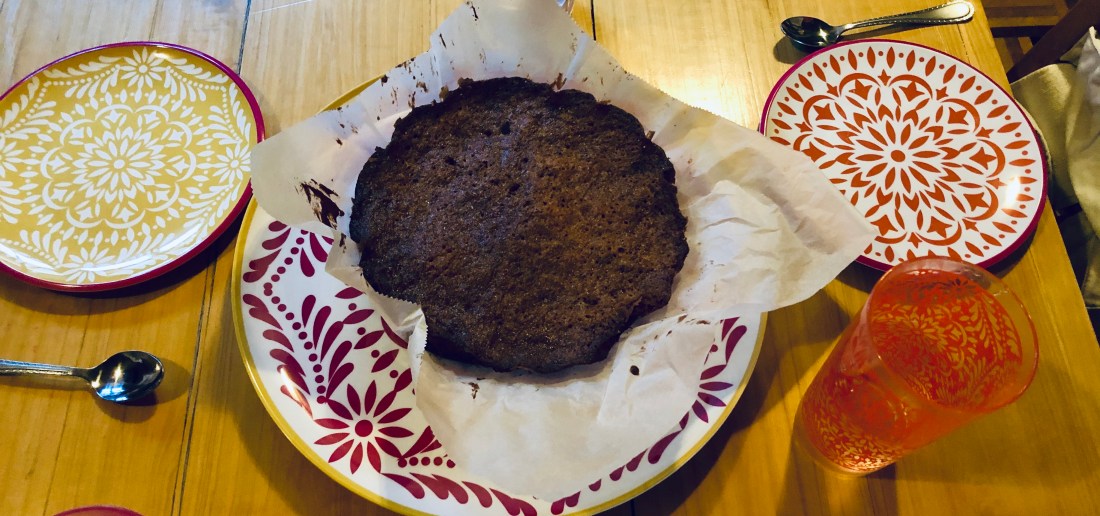
Recipe Thursday: Big Cookie

For most of our marriage, Nathan has been encouraging us as a family to do a Sabbath—to set aside a day for worship and rest. I’ve struggled with this . . . we’re busy, and I’ve always felt that I can’t just give up a whole day of checking things off my endless lists. Sometimes I’ve agreed to do it . . . only to fill the “Sabbath” day with other kinds of projects I normally don’t have time to do, much to Nathan’s frustration. 

Recently, I was listening to Jennie Allen’s podcast and an interview she did last fall with John Mark Comer. He has a recent book—The Ruthless Elimination of Hurry. During the podcast, they talked about how the Cromer family practices Sabbath. They set aside a whole day for rest, worship and fun, beginning with a family dinner and—get this—an enormous cookie! That’s right—they take cookie dough and fill a cast-iron skillet, cook it in the oven, then dump it out with ice cream in the middle of their table. They all share it as they tell their highs and lows for the week.  

When I heard this podcast, I suddenly had a new understanding—so that’s what Sabbath is all about?? Taking time to rest and truly enjoy God and His blessings? To be honest, though, the main thing I heard was BIG COOKIE! I can get behind a big cookie in a cast-iron skillet! 

With the restrictions of COVID-19, we decided if we were ever going to be able to pull off a real Sabbath, now was the time to try. We’ve enjoyed the last month or so of setting aside a day for rest, for family fun, family worship, and, of course, making and enjoying the big cookie together!

This is the recipe we’ve been using, with some variation:

  • We use our famous, dark Madagascar Robert chocolate bars cut into chunks.
  • We don’t have any brown sugar, so we do all white except for the extra 2 tablespoons we use local honey.
  • We use local Madagascar vanilla extract we’ve made ourselves! 
  • We leave off the flaky sea salt at the end.
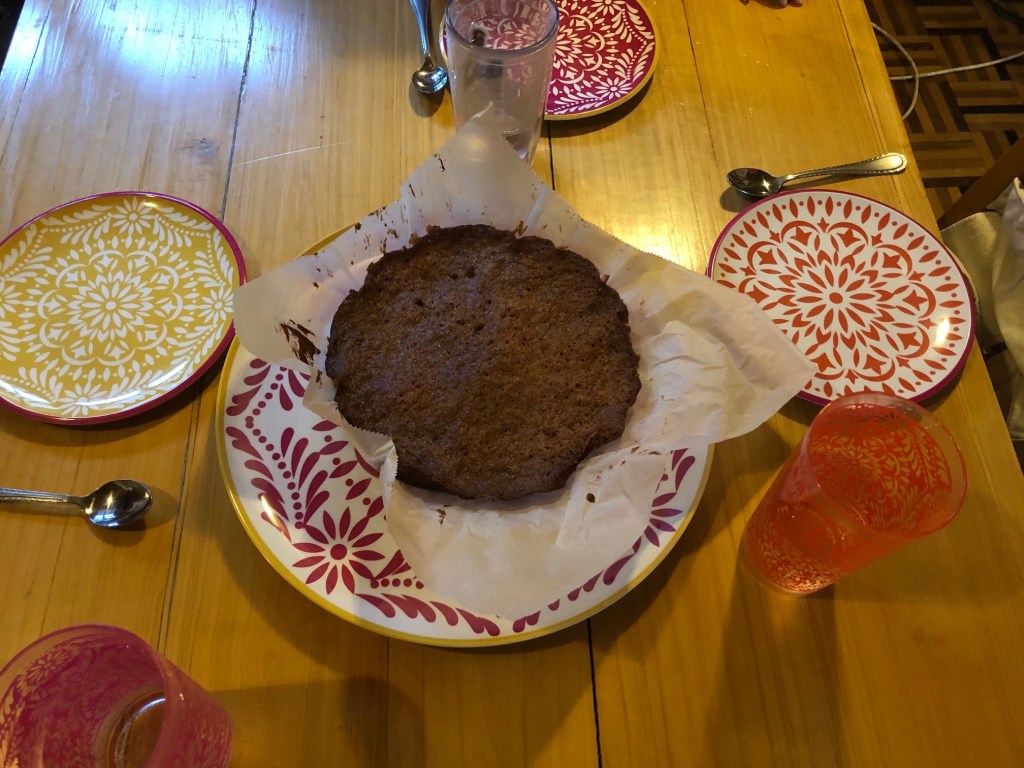
Hope you enjoy—both a huge cookie and the rest God created us to need in Him! 
Fruitfulness in the time of pandemics

Land your hand on my shoulder, Holy Dove. Hold me
down to the ground, a paperweight rock on my fluttering heart—
frantic feather between your fingers inscribing 
indescribable things. 
 
Please, keep me from flying away.
 
Speak your words over me, ‘til they drip like
oil-like-lead down into my shoes.
Keep me planted on the earth. 
Sink deep roots through my twitchy feet. Feed me
from the bottom up—up from earth’s core,
deeply dug glory, subsisting in subpar, sublevel
underground stories of futility:
the fickle smear of bone and fleshy vanity,
digested, petty dreams.
 
Break up, tear down,
Humble, till, and turn my ambition and excesses into
life-giving nutrition.
Compose me new in compost piles. 
Re-make me true.
 
May the holy seed rise up
in me, a growing in obscurity—warmed
by a single naked beam of your kenotic light. 
 
Bow my neck and bend my boughs
in ignominious productivity.
Burden me with real success, branches filled by, 
stooped, by bearing Spirit’s fruit.

Manuely

For the past couple of weeks, I’ve been meeting with a couple young guys here in Toliara. We’re studying through the book of James as well as planning how to help the community in this crisis. I wanted to give them a chance to encourage you as well with what we’re learning. Here’s Manuely . . .

Transcript: Good morning, everyone! We thank God for this wonderful day he has given us, so that I can share with you what I have learned from God’s Word. I have been studying with Nathan Baker. Thanks to Nathan Baker for teaching me in English. If it wasn’t for God’s Spirit using Nathan, I wouldn’t be speaking English. I hope that you can understand me now.

The one thing I want to share with you today is about temptation. You know that we have a problem around the word because of this COVID-19, right? But that doesn’t mean we should stop preaching the gospel. Instead, we should communicate with our family and take advantage of this time to share God’s Word. Especially, we have a lot of churches not open because of this virus. Worshippers of God are discouraged, because you do not understand what has happened. People are asking, “Is this from God, or from evil?” But if you worship God, don’t be afraid.

James says, “Let no one say when he is tempted, ‘I am being tempted by God,’ for God cannot be tempted by evil. And he himself does not tempt anyone.” What does that mean? That means, He is not testing you. Instead, he gives you a choice, to trust him or to blame him. But you should know, like James says, the good things you have are from God. Even if you blame him, he is good and he does not change.

For proof of that, you can read 1 Corinthians 10:13. It says, “No temptation has seized you except that which is common to man. God is faithful, he will not let you be tempted beyond what you can do. But when you are tempted, he will also provide a way so that you can stand up under it.”

So for us, we should have courage and remember, God has given us a way out in Jesus. And even in COVID-19, we can stand strong in him. I guess, that’s all today. Thank you for listening and watching me. God bless you wherever you go and whatever you do. Bye!

Remember the Poor . . . even in a Pandemic

Just recently, I stumbled on a wonderful collection of resources by Lausanne Conference (evangelical group for world missions) for leading through COVID-19. I was struck and convicted by what I heard from these global leaders. This webinar was put on by Lausanne to discuss the global impact of COVID-19 on the poor and vulnerable–especially majority or 3rd world contexts.

Ivan in the above video taken from that webinar, said . . .

“For those for whom survival is an issue, ya know, they don’t mind the possibility of contracting the disease [COVID-19] if that means . . . when the option is to die of hunger. And that’s what it boils down to. I think, ya know, what several speakers have pointed out this . . . The irony is, an estimated 200 to 250 people die every day in India of poor man’s diseases: diarrhea, dysentery, water-borne diseases. And that happens as a matter-of-course. So, to some extent, yes, it [government mandated social-distancing measures] is something that is protecting the middle-class, people of power and wealth, at the expense of not just inconvenience but life-threatening, existential problems that the poor are facing. And I think it’s not just a question of India, metropolitans in India, but it’s across the globe, I would imagine, it’s the same issue.”

Ivan Satyavrata

For those who are interested in this webinar, it’s linked above and I’ve also attached my Brief of the 90 minute conversation with appropriate info and quotes.

As a disclaimer, I’m really not weighing in on the Open vs. Reopen debate in America (or elsewhere for that matter). Listening to this, I was blown away by my inability to understand what poor, vulnerable communities need right now–and I live in and near  vulnerable communities in one of the poorest economies on earth!

I’m not sure exactly what to do with this either. First, we pray. Christian prayer and reflection leads us to compassion and social action. How can we join into the grief of our local and international communities who are more at risk? Reach out to those near you and those in or near at-risk places internationally, just to listen.

I am meeting with friends here locally to listen and pray. So many have already asked us for money, jobs, food . . . hope. I know I can’t just tell them God has them and hope for the best. We will have to figure out together what we can do to provide physical relief now and moving forward. It’s long overdue.

What good is it, my brothers and sisters, if someone claims to have faith but has no deeds? Can such faith save them? Suppose a brother or a sister is without clothes and daily food. If one of you says to them, “Go in peace; keep warm and well fed,” but does nothing about their physical needs, what good is it? In the same way, faith by itself, if it is not accompanied by action, is dead. (James 2:14-17)

Coming away from this webinar, I was reminded how we have to risk coming alongside the poor and hurting communities–just as God did for us. It is how, as MLK said, the church is able to fulfill its role as the conscience of the city. I don’t know what that means for you. If we were in America, I think in some ways it’s more obvious where the pressure points are . . . even if it’s not clear what to do about it. Honestly, I don’t know what it means for us here either. But let’s not use that as an excuse for doing nothing.


Pentecost Now!

The Universe has as many different centers as there are living beings in it. Each of us is a center of the Universe,”

Aleksander Solzhenitsyn, The Gulag Archipelago, 3.

Read: Acts 2

What’s changed? If we’re looking at the world around us, maybe nothing. But that’s not where Pentecost starts. As the world-wise Solzhenitsyn wrote, any one of us is the center of the Universe. A crime against another is a crime against the universe; on the other hand, change the hearts of a few and you have started a universal revolution.

That’s what happened at Pentecost. Jesus started a heart renovation project in a few that in short order up-ended the entire world. I believe that’s what is happening today if we allow God to let his Spirit run rampant in us.

Resources: 

If you want to make the world a better place
Take a look at yourself, and then make a change

Michael Jackson, Man in the Mirror


Waiting – Day 10

“But it is exactly in common searches and shared risks that new ideas are born, that new visions reveal themselves and that new roads become visible.

We do not know where we will be two, ten or twenty years from now. What we can know, however, is that man suffers and that a sharing of suffering can make us move forward.

The minister is called to make this forward thrust credible to his many guests, so that they do not stay but have a growing desire to move on, in the conviction that the full liberation of man and his world is still to come”

Henri Nouwen, The Wounded Healer, 100.

Read: Habakkuk 3:12-19

When Habakkuk asks God what’s going to happen to his nation, God tells him he wouldn’t believe him if he told him—it’s going to be that bad! But after back and forth questioning, Habakkuk sees that even in the face of disaster—even if the economy absolutely fails (v. 17)—God can still be trusted. In fact, he rejoices that God is a God who can not only save us in the midst of a broken economy, but he will actually transform us so we can walk through the hard times (vv. 18 – 19)! What’s God doing in our nation? Let’s ask and trust God to steel us and transform us—whatever happens next.

“Whoever has ears, let them hear what the Spirit says to the churches.”

Resources:

For help understanding what’s going on in Habakkuk’s story, check out Bible Project’s Overview of the story. Plus they have a video on Hope as well.


Waiting – Day 9

Read: 2 Thessalonians 3 (see 1 Thessalonians 4:1-12 for more context)

People were expecting Jesus to come any day. Some leaders were saying it was the end. But Paul reminds us to not worry when the end will come; we wait while being productive until it does. Work, feed your family, make some money so you can help those who cannot. This is not frantically working to get ahead. We can work hard without worry because God is faithful and our future is secure in Jesus. What are we filling our time with that doesn’t matter? How can we make ourselves more useful to those in need?

“Whoever has ears, let them hear what the Spirit says to the churches.”

I believe that though our current global moment is in so many ways different from the early church’s, this kind of life is the way forward. To live ordinarily and quietly, work with our hands, embrace the rhythms and realities of daily life, is seemingly mundane. However, it is actually how we engage in the great spiritual battle against the flesh and the powers and principalities. One could be fooled by such a quiet life, yet when tuned to a heavenly frequency, such a life resounds with a mighty roar.

Mark Sayers, Strange Days, 166.

Resources: 

  • I just finished reading Mark Sayers’ Strange Days (above quote) and he’s brilliant. He does a great job at both cultural analysis and pushing us for a more biblical, Spirit-fueled life. It helped me make sense of some of what’s going on around us now, how we got here. Plus, his advice on living a scaled-back life landed with me because of where we are right now. Check it out! You can also listen to him on the This Cultural Moment podcast.

Waiting – Day 8

Read: Psalm 4

In the middle of crisis, relying on God—begging him to answer us—relieves our stress. David reminds us here that instead of relying on worthless and deceptive information and techniques (which refers to our propensity for idolatry), he has turned to the living God. Only God has answers. Not only does this empower David to give actual sound advice to others (vv. 4 – 5), he can sleep in peace. Are you able to be angry without lashing out right now? Let’s search our hearts in silence and stop speculating. Let’s bring everything we have before God and trust him by waiting on him to answer.

“Whoever has ears, let them hear what the Spirit says to the churches.”

“Listen, O Lord, to my prayers. Listen to my desire to be with you, to dwell in your house, and to let my whole being be filled with your presence. But none of this is possible without you. When you are not the one who fills me, I am soon filled with endless thoughts and concerns that divide me and tear me away from you. Even thoughts about you, good spiritual thoughts, can be little more than distractions when you are not their author.

O Lord, thinking about you, being fascinated with theological ideas and discussions, being excited about histories of Christian spirituality and stimulated by thoughts and ideas about prayer and meditation, all of this can be as much an expression of greed as the unruly desire for food possessions, or power.

Every day I see again that only you can teach me to pray, only you can set my heart at rest, only you can let me dwell in your presence. No book, no idea, no concept or theory will ever bring me close to you unless you yourself are the one who lets these instruments become the way to you.

But Lord, let me at least remain open to your initiative; let me wait patiently and attentively for that hour when you will come and break through all the walls I have erected. Teach me, O Lord, to pray. Amen.”

 Henri Nouwen, A Guide to Prayer for Ministers and Other Servants.

Waiting – Day 7

Jesus in his solidarity with the marginal ones is moved to compassion. Compassion constitutes a radical form of criticism, for it announces that the hurt is to be taken seriously, that the hurt is not to be accepted as normal and natural but is an abnormal and unacceptable condition for humanness . . .

Empires are never built or maintained on the basis of compassion. The norms of law (social control) are never accommodated to persons, but persons are accommodated to the norms. Otherwise the norms will collapse and with them the whole power arrangement. Thus the compassion of Jesus is to be understood not simply as a personal emotional reaction but as a public concern against the entire numbness of his social context.

Walter Brueggemann, The Prophetic Imagination 

Read: Isaiah 58

God does not care if we fast, pray, and busy ourselves with “religious activity,” all the while ignoring injustice and suffering around us. Do we really care about others? Our efforts now to draw close to God mean nothing if we ignore the needs of those around us. In fact, we see by the end of this chapter, we will not find satisfaction in God until we stop working so hard for our own satisfaction. As we meet as churches, either virtually or face-to-face, how do we need to “pivot” from religious activity to loving God by loving others? In the midst of, or coming out of, this crisis, how can we “fast from injustice and oppression” as God says?

“Whoever has ears, let them hear what the Spirit says to the churches.”

Resources:

For more information on the idea of “Sabbath” check out this Sabbath video from Bible Project.

“God of hope, whose spirit gives light and power to your people, empower us to witness to your name in all the nations, to struggle for your own justice against all principalities and powers and to persevere with faith and humor in the tasks that you have given to us. Without you we are powerless. Therefore we cry together: Maranatha [O Lord, come].”

Thomas G. Pettepiece, A Guide to Prayer for Ministers and Other Servants, 193.

Waiting – Day 6

“When we want to be something other than the thing God wants us to be, we must be wanting what, in fact, will not make us happy. . .

[God says to us] ‘You must be strong with my strength and blessed with my blessedness, for I have no other to give you.’ That is the conclusion of the whole matter. God gives what He has, no what He has not: He gives the happiness that there is, not the happiness that is not. To be God—to be like God and to share His goodness in creaturely response—to be miserable—these are the only three alternatives. If we will not learn to eat the only food that the universe grows—the only food that any possible universe ever can grow—then we must starve eternally.”

C. S. Lewis, “The Problem of Pain,” The Complete C. S. Lewis Signature Classics, 578.

Read: Isaiah 55

Do you feel empty? In a time of exile, when if anything people feel farther away from God, God reminds them that he still makes himself available. We spend our resources on so many things that don’t bring us any more life. God is offering full satisfaction of ultimate value that is given, not bought. His economy, his modus operandi, is fundamentally different (i.e. better) than ours. And just like at creation, what he speaks is what will happen. Bend your ear to God. Come to him. “Listen, that you may live.”

“Whoever has ears, let them hear what the Spirit says to the churches.”